
This success story highlights how a public utility client improved its water meter request and setting process by clarifying cross-departmental requirements, reducing manual rework, and creating a stronger foundation for future system integration.
Executive Summary
The client faced a complex and labor-intensive water meter release process that required coordination across multiple internal departments and external stakeholders. The process was especially important because water meter release supported a key step in enabling new occupants to obtain a certificate of occupancy. However, the existing workflow involved manual interventions, unclear requirements, and frequent changes after permitted design approval. It was estimated that 30% of water meter releases involved changes to meter type, quantity, size, or water impact fees.
Dillon Morgan Consulting supported the client in redesigning the water meter request and setting process through a structured process improvement engagement. The project focused on defining cross-departmental requirements, standardizing the inspection process, streamlining the request workflow, and establishing a more reliable source of truth for water meter-related information that could support future Salesforce integration.
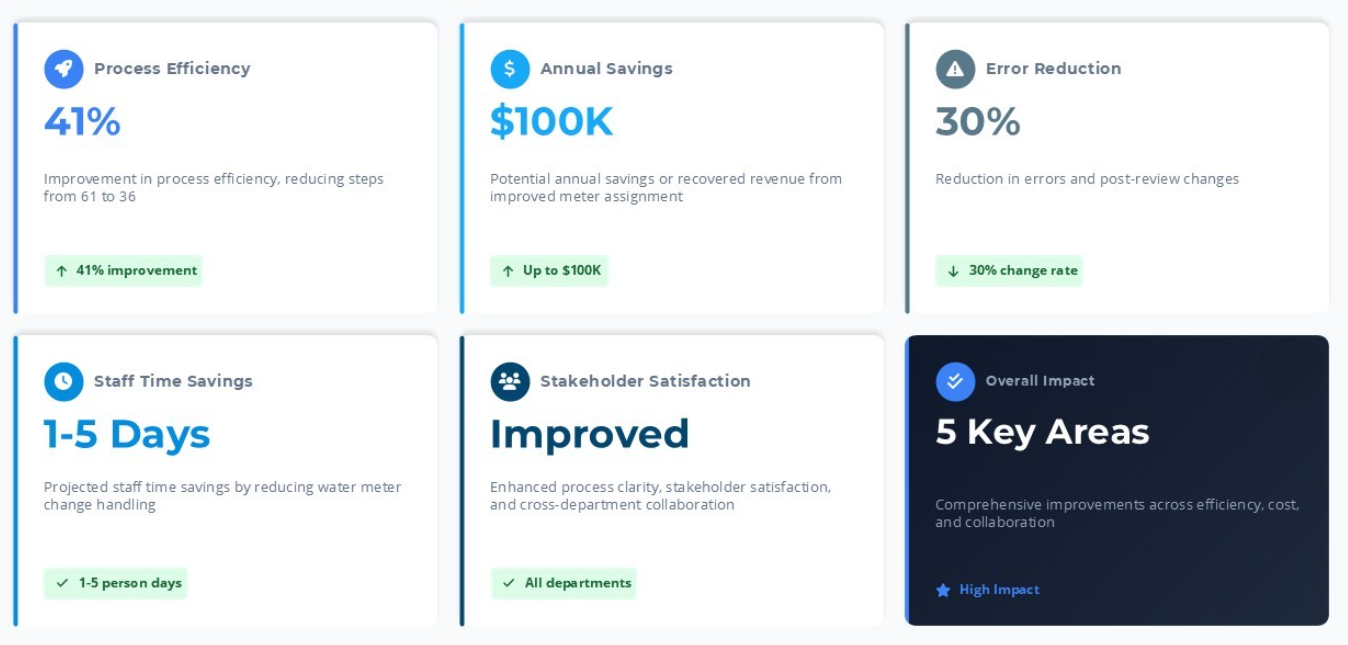
Key results include:
Background
Water utilities are a critical part of community infrastructure, and the water meter release process plays an important role in supporting service activation for new residents, businesses, and development projects. For the client, the process required coordination across Building Inspection, Development, Field Engineering, Customer Service, the Water Department, developers, and plumbers.
Before the improvement effort, the process was highly manual and vulnerable to rework. Developers completed blank water meter release forms, which created opportunities for human error or change requests that had not gone through the appropriate review process. The client also identified challenges related to site address versus billing address information, meter type and pricing differences, inspection ambiguity, email-heavy communication, and inconsistent compliance with plan revision requirements.
Developer feedback also pointed to the need for clearer roles, better continuity of information after pre-construction meetings, and improved timeliness in obtaining meters.
Approach
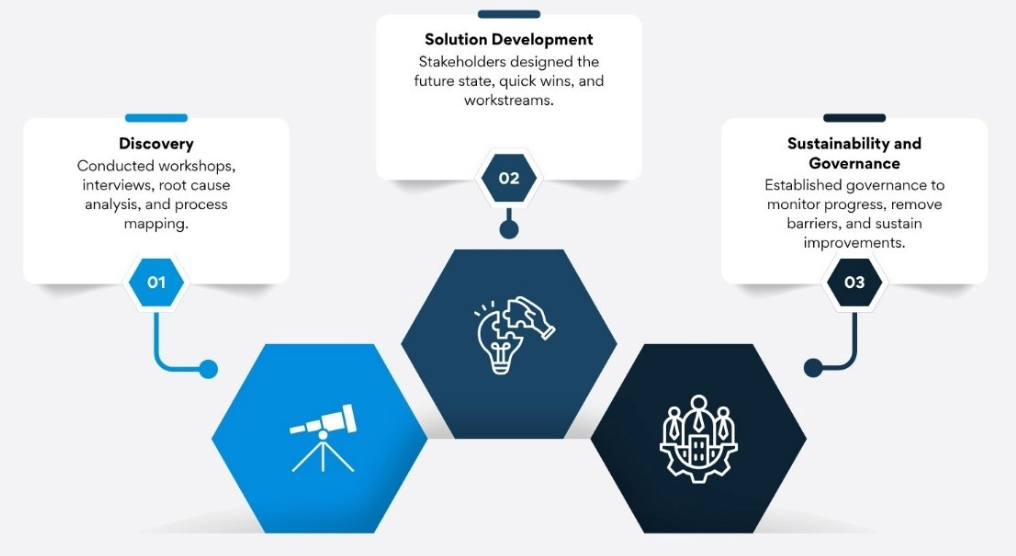
DMC used a structured three-phase process improvement approach to assess the current state, design the future state, and establish sustainability mechanisms.
Phase 1: Discovery
The discovery phase focused on understanding departmental needs and identifying gaps in the end-to-end water meter request process. Activities included document review, cross-departmental workshops, one-on-one interviews, root cause analysis, and development of the current-state process map. Three workshops were conducted during discovery, including two root cause analysis sessions.
Phase 2: Solution Development
During solution development, key stakeholders from impacted departments worked together to design the future-state process and develop solutions for the improvement opportunities identified during discovery. Two cross-departmental workshops were conducted to develop the future-state process flow.
The team categorized solutions as either quick wins or workstreams. Quick wins were solutions that could be closed within the calendar year, while workstreams required cross-department engagement and additional time to complete. The resulting future-state process was documented in a to-be process map and supporting SOP narrative.
Phase 3: Sustainability and Governance
The final phase focused on sustaining the improved process. The project team organized the identified improvements into workstreams, assigned ownership, and recommended a governance cadence through a Process Group. The governance structure was designed to help leaders monitor workstream progress, address barriers, and continue identifying additional improvement opportunities.
Efficiencies & Cost Savings
The project delivered meaningful quantitative benefits.
The future-state process reduced the number of process steps from 61 to 36, representing a 41% improvement in process efficiency. This improvement was primarily tied to eliminating errors and reducing unnecessary rework.
The project also identified potential annual savings or recovered revenue of up to $100,000 by streamlining how water meter types are assigned and how water meter and impact fees are calculated.
In addition, the client estimated that 30% of water meter applications previously required changes because of errors or developer-requested changes after approved plan reviews. The redesigned process was projected to reduce this change rate and save approximately 90 minutes per incident, or between 1 and 5 person days of staff time over a year.
Impact
The engagement successfully achieved the objectives defined at the start of the project. Through cross-department collaboration, the client developed and vetted an optimized water release management workflow with key stakeholders. The project identified nine improvement opportunities within scope and two additional opportunities outside the original project scope.
The future-state process created clearer expectations for when water meter data should be submitted, how meter details should be verified, when revisions are required, and how departments should coordinate installation, inspection, documentation, and closeout.
Benefits
The improvement project delivered benefits across operations, governance, customer experience, and future readiness.
Operational Efficiency: The redesigned workflow reduced unnecessary steps, manual handling, and rework caused by inaccurate or incomplete information.
Improved Revenue Accuracy: The process improvement helped address gaps related to meter type, meter pricing, and water impact fee calculation.
Process Clarity: The project clarified departmental requirements and inspection expectations, reducing confusion across the workflow.
Improved Stakeholder Experience: A simplified request process was expected to improve the experience for developers and other stakeholders.
Cross-Department Collaboration: The engagement brought together multiple departments to align on root causes, solutions, future-state workflows, and governance needs.
Future System Readiness: The project established a stronger foundation for a centralized and reliable source of truth that could support future Salesforce integration.
Governance & Change Management
Sustainability was a core part of the project. The final phase established a governance model to ensure that the identified workstreams could be delivered, managed, and evaluated over time. The recommendation was to form a Process Group made up of workstream drivers and leadership, supported by a regular governance cadence.
This structure gave the client a practical mechanism to sustain the improvements, monitor progress, and continue addressing new opportunities as they emerged.
Conclusion
This water meter request process improvement project demonstrates how public utility operations can modernize complex, cross-departmental workflows while improving governance, customer experience, and operational discipline.
By reducing process steps, improving data quality, clarifying requirements, and aligning stakeholders around a future-state workflow, the client created a stronger and more sustainable process for managing water meter requests and settings. The project also positioned the organization for future system integration by strengthening the process foundation before broader technology deployment.