
From Reactive Repairs to Smarter, Data-Driven Fleet Management
The North Texas City operates one of the most diverse municipal fleets in North Texas, supporting sanitation, public safety, utilities, streets, and parks. As the City advanced its broader operational excellence agenda, Fleet Operations identified a critical opportunity: evolve from reactive maintenance practices toward a more predictive, data-driven model.
To help make that shift, the City partnered with Dillon Morgan Consulting (DMC) to design an analytical foundation for better repair-routing decisions, improved capital planning for high-cost wear parts, and more proactive preventive maintenance scheduling. The effort was intended to improve fleet uptime, reduce repair backlog, and better balance operating and capital expenditures.

The Challenge
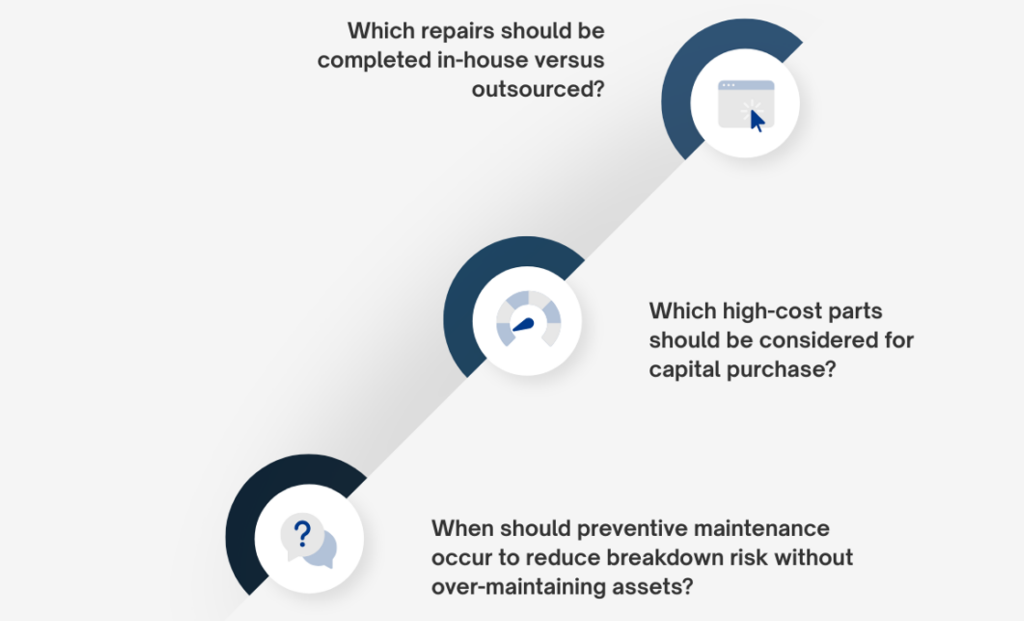
Like many municipal fleet organizations, the city had a knowledgeable team and a strong service mindset. But improving performance at the next level required more than experience alone. Leadership needed a more structured and repeatable way to answer key operational questions:
The project also surfaced broader data and decision-making challenges. For example, more than 60% of high-effort repairs in a tested sample had previously been outsourced without structured decision criteria, and inconsistent task coding limited how precisely failure patterns could be analyzed.
The Solutions
DMC applied a three-phase approach to move the city from analysis to long-term adoption:
1. Discovery and Triage Model Development
The first phase focused on gathering relevant fleet data and building a triage framework to objectively determine whether work should stay in-house or go to an outside vendor. A weighted decision model was created using factors such as repair complexity, technician skill requirements, parts and tool availability, warranty conditions, downtime sensitivity, safety, workload capacity, and cost comparison. A prioritization model was also built to rank work orders by urgency, effort, complexity, and resource availability.
2. Predictive Modeling for Parts and Maintenance
The second phase translated raw fleet data into predictive insight. City’s team combined multi-year records from parts issues and failure-spell datasets into an analytic base of roughly 50,000 records. Statistical models, including Weibull, Lognormal, and Exponential distributions, were then applied to estimate part-failure patterns and generate survival and failure-probability curves.
This phase also produced a preventive-maintenance recommendation model. The default logic recommended scheduling maintenance when a part reaches a 25% probability of failure, while allowing users to adjust the threshold depending on asset criticality. Guardrails were added to keep recommendations practical, including minimum and maximum interval limits and cadence rounding to realistic PM cycles.
3. Adoption, Governance, and Sustainability
The final phase focused on turning the work into an operating model rather than a one-time analysis. Five sustaining workstreams were established around automation, capitalization of high-cost wear parts, fleet operations, data quality and insights, and predictive models. Garland also outlined an adoption roadmap that included AssetWorks integration pilots in 2026, model recalibration tied to data-quality improvements, and ongoing oversight through the Garland Transformation Office.
Key Improvements
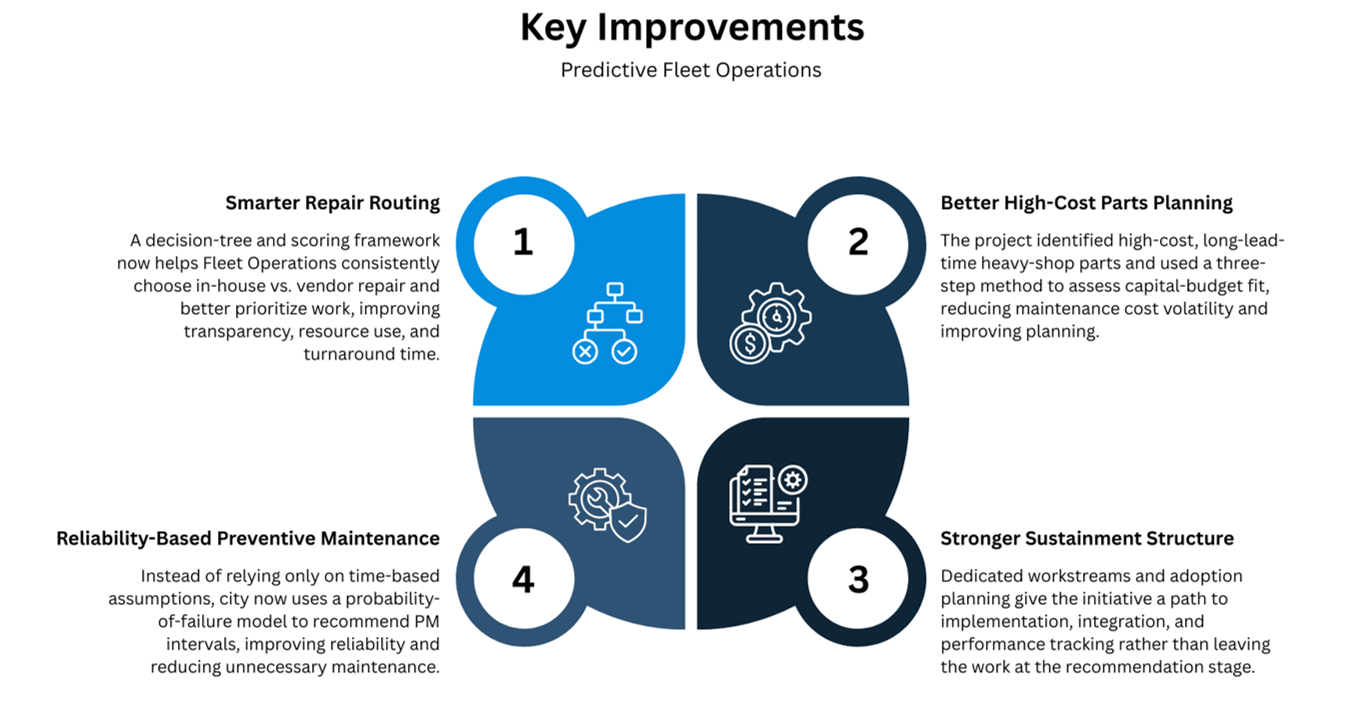
1. Smarter Repair Routing
A structured decision-tree and scoring framework now gives Fleet Operations a more consistent way to determine in-house versus vendor repair and prioritize workloads. This improves transparency, resource allocation, and turnaround time.
2. Better High-Cost Parts Planning
The project identified heavy-shop parts with significant replacement costs and long lead times, then applied a three-step approach to determine which ones may be suitable for capital-budget inclusion. This helps reduce volatility in maintenance spending while improving planning.
3. Reliability-Based Preventive Maintenance
Instead of relying only on time-based assumptions, the city now has a framework for recommending PM intervals based on modeled probability of failure. That creates a more evidence-based way to improve reliability and reduce unnecessary maintenance activity.
4. Stronger Sustainment Structure
Dedicated workstreams and adoption planning give the initiative a path to implementation, integration, and performance tracking rather than leaving the work at the recommendation stage.
Impact
Because the engagement focused on model development and recommendation design rather than full implementation, the outcomes in the report are projected. Even so, the business case is strong. The city identified the potential for:
- At least 10% average reduction in vehicle out-of-service days in Year 1 pilot conditions
- 10–15% operations efficiency improvement over Years 1–2 through reduced vendor repairs and overtime
- $50K–$150K reallocated to capital through high-cost part reclassification
- 20–25% fewer breakdowns through improved maintenance reliability over time
The initiative also outlined important qualitative benefits, including more transparent repair decisions, faster turnaround, better alignment between asset life cycle and funding, reduced emergency procurement costs and stockouts, stronger capital-planning justification, and a more resilient fleet operation overall.
Why It Matters
This case shows that predictive fleet management is not just about analytics. It is about improving operational judgment, financial stewardship, and service reliability at the same time.
For city leaders, the broader lesson is clear: when maintenance, capital planning, data quality, and repair-routing decisions are aligned, fleet performance becomes more predictable, more defensible, and more sustainable. The City’s work demonstrates how a city can combine institutional knowledge with analytical tools to move toward faster, smarter, and more fiscally responsible fleet operations.
What’s Next
The Fleet Predictive Operations initiative established the foundation for a longer-term transformation. The next step is implementation: integrating the models into day-to-day workflows, improving data quality, validating recommendations through pilots, and continuing to refine the system over time. The City’s roadmap points toward AssetWorks integration, model recalibration, and sustained reporting as the mechanisms that will turn predictive insight into operational practice.