
Over the years, we have had the privilege of guiding municipalities through a labyrinth of outdated processes, strained resources, and ever-growing community expectations. We have discovered that true transformation transcends mere problem-solving; it is about cultivating a culture of continuous improvement that positions cities and towns for enduring success.
What follows is not just theory – it is a battle tested playbook. We have distilled our experiences into four crucial steps that, when thoughtfully implemented, have consistently propelled local governments to remarkable success. Our aim is to inspire and educate those contemplating the journey toward continuous improvement and, ultimately, continuous excellence.’
The Transformation Journey
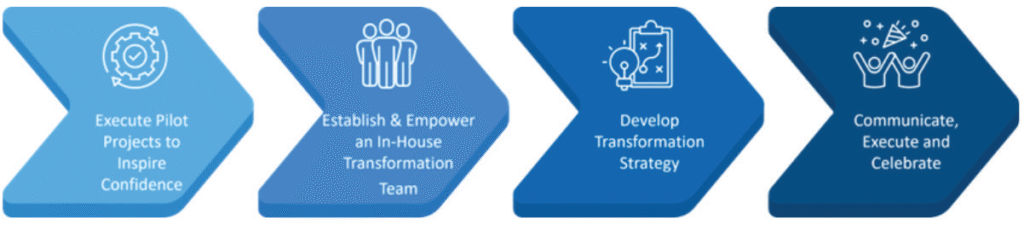
Execute Pilot Projects to Inspire Confidence
Over the years, we have had the privilege of guiding municipalities through a labyrinth of outdated processes, strained resources, and ever-growing community expectations. We have discovered that true transformation transcends mere problem solving; it is about cultivating a culture of.
Key Takeaway
Start small with appropriately sized initiatives, engage expertise when necessary, and celebrate successes. Demonstrated wins early on create the foundation for a broader transformation agenda.
Our aim is to inspire and educate those contemplating the journey toward continuous improvement and, ultimately, continuous excellence.
Establish and Empower an In-House Transformation Team
Sustainable change requires internal champions. Research shows that municipalities with dedicated innovation teams enjoy higher staff satisfaction and engagement. Once initial pilots validate the transformation effort, establish a Transformation Office led by a senior executive and populated by a diverse, cross-functional team—from IT and finance to public works and recreation.
While enthusiasm for change is often present, a shared understanding of implementation strategies may be lacking. To address this gap, consider implementing a Business Transformation Leadership training program. Aligning such a program with established frameworks like Lean Six Sigma methodologies can enhance its credibility and provide opportunities for personal growth. It is important that the training program goes beyond classroom delivery to include hands-on coaching, allowing participants to apply their learning to real-time projects.
In one of our engagements, we developed the business case for establishing a Transformation team, trained over 40 enthusiastic leaders in Business Transformation who went on to take the Lean Six Sigma Green Belt certification offered by the DMC Academy, and guided them through their initial process improvement projects. A robust internal team not only drives projects forward but also fosters a culture of problem-solving and continuous improvement, transforming skepticism into empowerment.
Key Takeaway
Empowerment begins with assembling a cross-departmental team that is well-trained, supported, and aligned with the organization’s long-term vision.
International City/County Management Association (ICMA) in its research demonstrates that municipalities with dedicated innovation teams can see a 20% increase in staff satisfaction and engagement, underlining the importance of internal champions.

Our aim is to inspire and educate those contemplating the journey toward continuous improvement and, ultimately, continuous excellence.
Develop Transformation Strategy
Transformation is not merely about fixing broken systems; it is about aligning with a city’s long-term vision. After achieving initial successes and assembling a team committed to continuous improvement, it is time to define or refine a comprehensive transformation strategy.
This is the moment for your Transformation Office to develop a SMART (Specific, Measurable, Actionable, Realistic, Timebound) strategy for the organization. A strategy crafted at this juncture has a higher likelihood of success because the organization now appreciates its value and has empowered staff to lead its execution. Consider leveraging external transformation experts for an objective perspective to complement your team’s efforts.
The Transformation Office typically operates across three key areas that collectively drive the organization toward continuous excellence:
1. Execution Against Strategic Plan
Develop an operating framework that augments the achievement of defined strategic goals by addressing how to prioritize initiatives, measure progress, manage expectations, govern the process, and communicate effectively to inspire stakeholders
2. Data-Driven Decisions from Insights & Analytics
Cities generate vast amounts of information daily; however, without proper structure and analysis, this data remains untapped potential. The goal is to deliver actionable insights that enable leaders to identify emerging trends, address challenges, predict.
3. Process Improvements Aligned with Strategic Goals
Executing process improvements for prioritized opportunities is the critical phase where ideas transform into tangible results. It is vital to ensure that improvements not only deliver immediate value but.
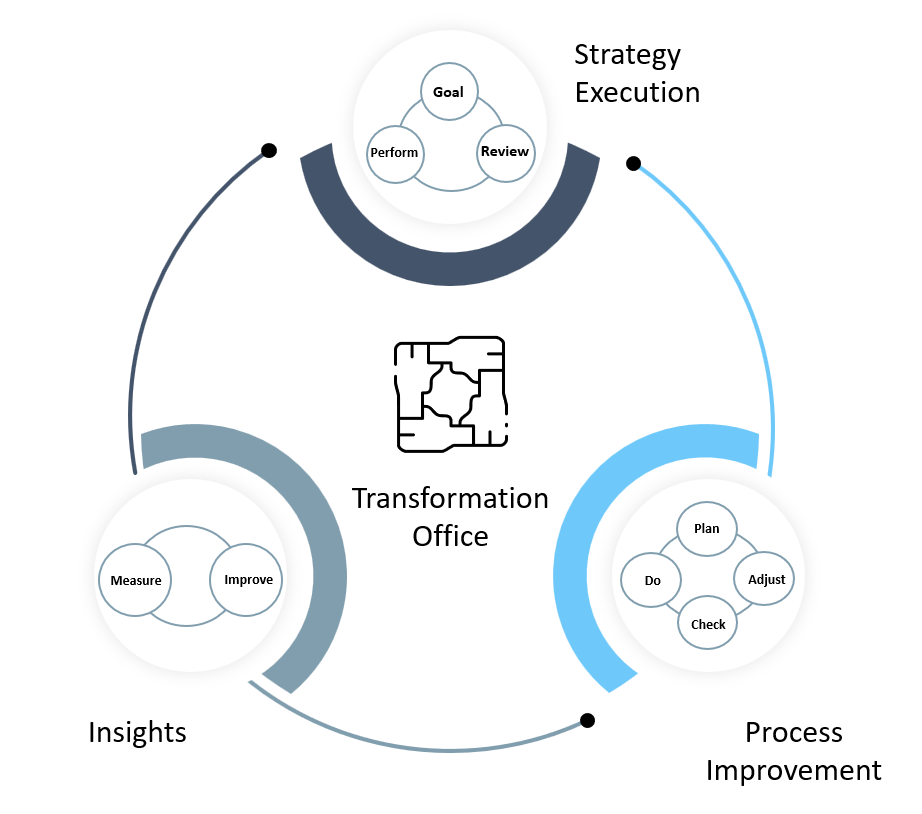
This requires evaluating whether the team is equipped with best practices and techniques, supporting project leaders to ensure success, and establishing methods to track and sustain improvements across the city.
A well-defined strategy becomes the roadmap for continuous excellence, ensuring that every initiative – from policy to processes – is aligned with the city’s overarching goals.
Communicate, Execute, and Celebrate
Even the most brilliant transformation efforts can falter without robust communication. A clear, consistent message bridges the gap between strategy and execution, aligning internal teams and engaging external stakeholders. Municipalities must articulate the “why” behind the vision, simplify complex information, and celebrate achievements to foster trust and momentum.
In one instance, a monthly Process Council Comprising transformation leaders and certified project experts – reviewed progress and addressed challenges. This ongoing dialogue ensured that feedback was incorporated and that both internal staff and the community understood the transformation journey.
Last but not the least, celebrate the success of Transformation teams and keep the momentum going.
Key Takeaway
Effective communication is the heartbeat of transformation. It builds trust, inspires action, and ensures alignment across all levels of the organization.
Transformation is a journey, not a sprint. From initiating small-scale pilot projects to empowering a dedicated transformation team, developing a clear strategy, and maintaining robust communication, every step is vital to creating lasting change.
Municipalities have the potential to evolve from reactive problem-solvers to proactive innovators, turning challenges into opportunities for excellence.
Key Takeaway
A robust transformation strategy connects actionable insights with measurable outcomes, ensuring every step propels the organization toward continuous excellence.
In fact, the Government Finance Officers Association (GFOA), notes that Transformational initiatives can lead to up to a 25% boost in operational efficiency for municipalities.
Deloitte research suggests that robust communication strategies can increase the likelihood of successful transformation by as much as 50%.
Your city is full of untapped potential. Whether you are ready to launch a pilot project or develop a comprehensive transformation strategy, Dillon Morgan Consulting is here to guide you every step of the way. Let’s unlock.
Imagine filing a site plan for a new development and receiving immediate feedback on its compliance – without any prolonged back-and-forth between designers and city staff. That’s the potential of AI-powered municipal permitting: a system that analyzes engineering or architectural drawings in real time and issues quick, precise guidance, or even approvals. While this vision sounds futuristic, it aligns perfectly with the core principles of business transformation – enhancing efficiency, reducing costs, and reallocating human talent to more strategic endeavors.
A New Era of Code Compliance and Transformation
Municipal permitting often suffers from the same bottlenecks that plague other industries: siloed communication, legacy procedures, and labor-intensive manual checks. Business transformation calls for rethinking these processes from the ground up, enabling a shift toward streamlined, tech-enabled workflows. By linking AI tools with design platforms – like AutoCAD, Revit, or GIS software – cities can integrate code compliance checks at the earliest stages of development, thus eliminating many of the re-submittals and repeated reviews that stall projects. Instead of engineering staff spending hours or days verifying documents, an AI-driven system identifies potential zoning or code violations on the spot. This doesn’t just speed up permitting; it illustrates how digital innovation can foster organizational change. Freed from repetitive tasks, planners and engineers can concentrate on long-range strategic or policy-driven responsibilities, echoing the essence of transformational thinking.
Rethinking Roles Through Business Transformation
A critical element of any transformation initiative is redefining how people contribute. In an AI-enabled permit review process, city employees shift from verifying every technical detail to leading high-level urban planning – crafting sustainable growth policies, engaging with communities, and analyzing data trends to guide future infrastructure investments. Even smaller developers or residents could benefit from user-friendly AI modules that automatically check local regs, broadening the circle of participation and innovation. Yet adopting AI-based permitting must be tempered by good governance: clear liability guidelines, robust data ethics, and ongoing human oversight. These elements are standard best practices in business transformation – recognizing that tech alone isn’t a magic bullet, but rather a powerful lever for re-imagining and improving organizational processes.
The Road Ahead
Yes, questions remain about legal liabilities, potential biases in AI algorithms, and public trust in automated decisions. But every business transformation journey faces complex hurdles before proving its value. With careful planning and policy work, AI permitting can streamline project timelines and strengthen compliance – while freeing employees to tackle higher-impact initiatives. By weaving AI into municipal permitting, local governments can demonstrate exactly what business transformation looks.